
Four hours on the desk, twenty-four in a cooler bag
Breast milk at work: how long it keeps, and how to keep it cold
Health agencies agree on the cooler bag: up to 24 hours with frozen ice packs. The room-temperature limit is set at 25°C, and in much of the world the office, the bus and the car are hotter than that.
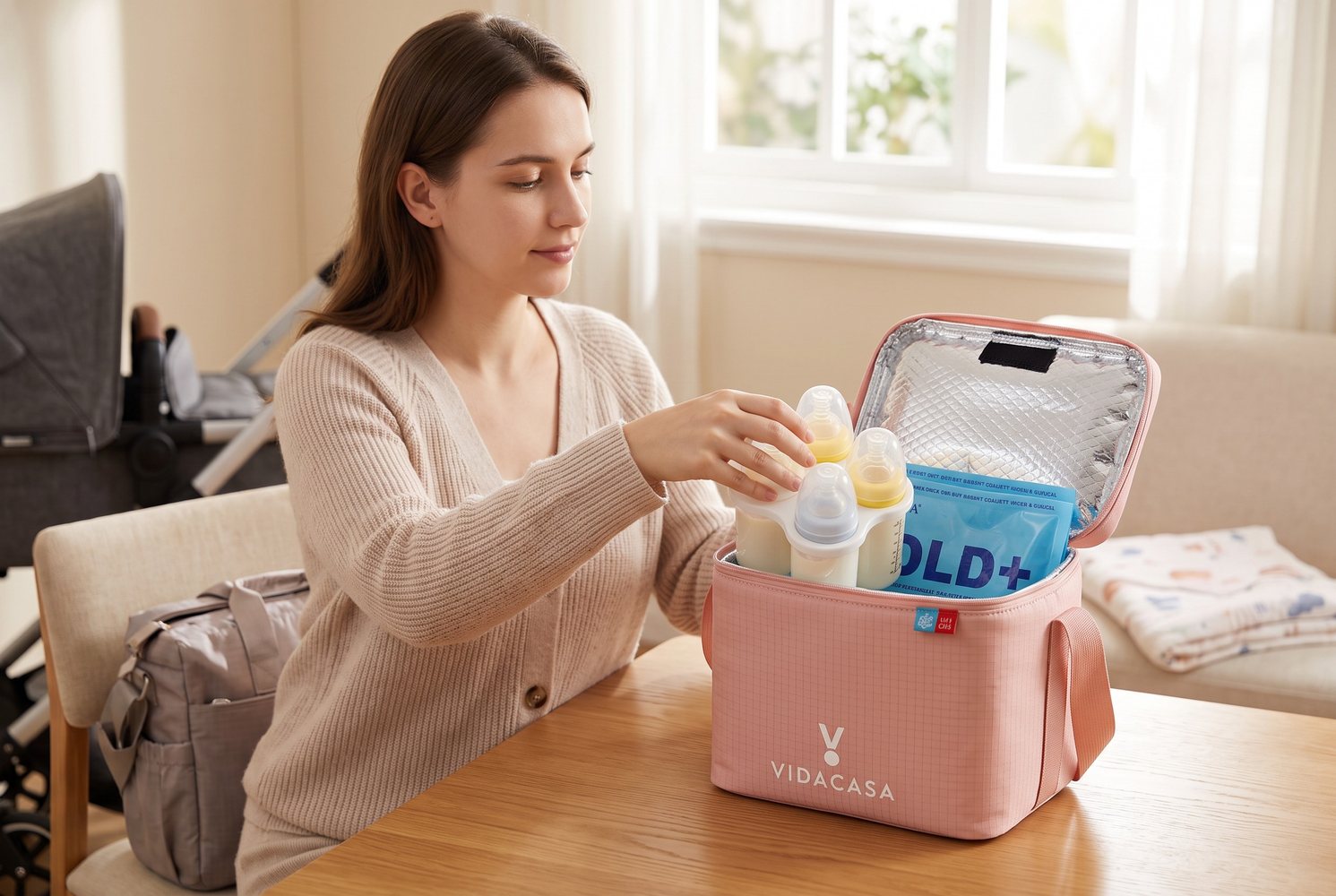
Going back to work usually means pumping at work, and pumping at work means one practical question: how long is the milk good for, and where does it wait until it gets home? The answers are published, and they are clearer than most parents expect.
What the guidance says
The US Centers for Disease Control and Prevention (CDC) gives these limits for freshly expressed milk:
- up to 4 hours at room temperature, at 25°C (77°F) or colder;
- up to 24 hours in an insulated cooler with frozen ice packs, when travelling;
- up to 4 days in the fridge;
- about 6 months in the freezer, and up to 12 months is acceptable.
Singapore's HealthHub, written by doctors at KK Women's and Children's Hospital, uses the same shape: 4 hours at room temperature (25°C), 24 hours in a cooler bag with an ice pack, 48 hours in the fridge at 4°C, and 6 to 12 months in a deep freezer. The UK's NHS allows up to 8 days in a fridge at 4°C or lower, and up to 24 hours in a cool bag with ice packs.
The fridge times differ from agency to agency, so follow the guidance where you live. On the cooler bag, all three agree: 24 hours, with ice packs.
The 25°C problem
Every room-temperature limit above is written for a room at 25°C or colder. That describes an air-conditioned office in the tropics. It does not describe the walk to the car park, a bus stop at noon, or a car left in the sun in Manila, Bangkok or Singapore. None of the agencies publishes a separate time for hotter rooms; the practical reading is simple: in the heat, do not rely on room temperature at all. Get the milk into a cooler bag with frozen packs as soon as it is expressed.
Where the workplace fits in
Some countries write the fridge into the rules. In the Philippines, the Expanded Breastfeeding Promotion Act (RA 10028) requires workplaces to provide lactation stations, and a 2025 government memorandum sets lactation breaks of at least 40 minutes per 8-hour working period and lists a refrigerator for expressed milk as required equipment. In Singapore, building owners must provide lactation facilities, and the Ministry of Manpower encourages flexible lactation breaks without mandating protected time. Even where there is a fridge, the milk still has to travel home.
A cooler bag routine that works
- Freeze the packs the night before, for 12 hours, until they are rock solid. A soft pack is not a charged pack.
- Put one pack under the bottles and one above, or wrap the packs around them, and keep the bag zipped.
- Label every bottle with the date and time it was expressed.
- At home, move the milk into the fridge or freezer straight away, and use it within the times above.
Why the pack matters
Ordinary gel packs and wet ice sit at 0°C and start warming as soon as they leave the freezer. The F10-200 pack in VIDACASA's MINUS TEN cooler bags freezes to −10°C, so it has further to go before the bag warms up. That margin is what you want on a hot day with a long commute. It does not change the rules above: follow your health agency's times, and ask your doctor or lactation consultant if you are unsure.